
The Great Regulatory Divide: Why the EU and U.S. Are Moving in Opposite Directions on AI Governance
Two Powers, Two Visions, One Technology
If you’ve been paying attention to AI policy over the past year, you’ve probably noticed something that would make any civics student sit up straight: the world’s two largest economic powers are heading in starkly different directions on how to govern artificial intelligence. On one side of the Atlantic, the European Union spent years building toward comprehensive regulation and is now implementing it. On the other, the United States just dismantled its most significant federal AI safety framework. This isn’t abstract policy debate. These choices will shape what tools get built, who gets to use them, and how the rest of the world decides to follow.
Here’s the thing about regulatory divergence at this scale: it matters for understanding not just what happens in Brussels or Washington, but what happens everywhere else. When the world’s largest single market imposes one set of rules and the world’s largest AI innovator imposes another, you get what economists call “regulatory arbitrage,” and the practical consequences ripple far beyond impressive conference presentations.
The EU’s Bet: Structured Implementation Over Time
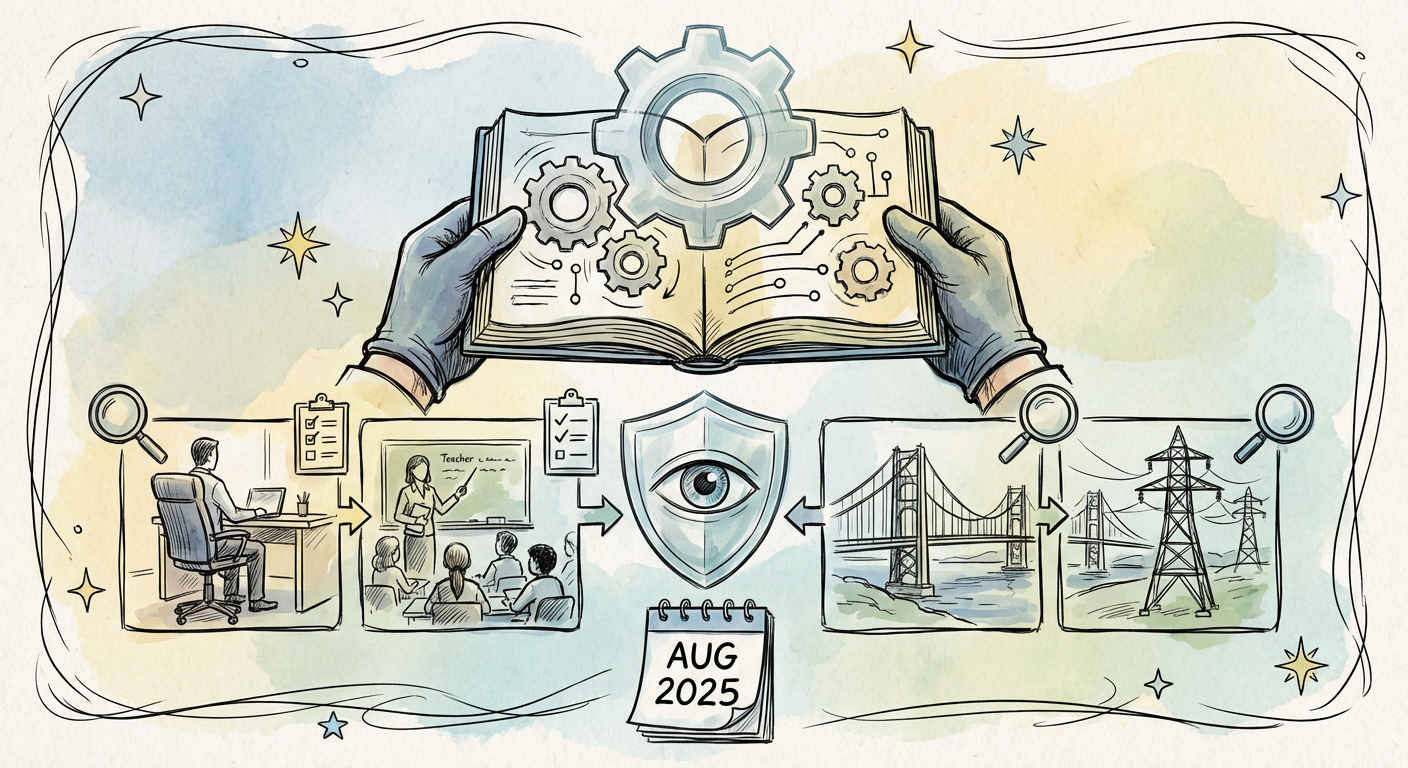
Let’s start with what’s actually happening in Europe right now. Starting in August 2025, the EU AI Act moved from theory into practice. This wasn’t some vague commitment or aspirational framework. High-risk AI systems, the ones deployed in hiring decisions, student evaluations, critical infrastructure management, and similar consequential areas, now face concrete requirements. Developers must conduct conformity assessments, maintain detailed transparency documentation, and build in human oversight mechanisms. If you’re using an AI system to screen job applicants in Frankfurt or manage power grids in Stockholm, regulators can now show up and verify you’re actually doing these things.
The EU AI Office, established in 2024 to oversee all this, released its first-year report showing over 200 formal complaints related to general-purpose AI model providers. That’s not a judgment about whether those complaints were valid or frivolous. What it tells you is that the regulatory infrastructure is working as designed: it’s creating visibility, establishing a complaint mechanism, and generating data about what’s actually happening in the market. For a brand-new regulatory agency in its operational first year, that’s real momentum.
You can dig into the specifics of how this implementation is supposed to work through the EU AI Act Official Text and Implementation Timeline. What strikes me about reading through these documents isn’t the bureaucratic language. It’s how deliberately sequenced the whole thing is. Europe essentially made a decision: we’re going to move carefully, build institutions as we go, and adjust based on what we learn. That approach has real costs in terms of speed and innovation. It also has real benefits in terms of legitimacy and durability.
The U.S. Reversal: Deregulation as Strategy
Now pivot to what happened in January 2025 in Washington. The Trump administration rescinded President Biden’s October 2023 Executive Order on AI Safety. That earlier order had established federal safety reporting requirements for frontier AI models, the cutting-edge systems that developers actually think might pose novel risks. It gave federal agencies authority to set guardrails. It created a baseline expectation that the highest-capability systems should be tested and documented before wide deployment.
The administration’s January action removed those reporting requirements and redirected agencies to prioritize AI competitiveness over precautionary regulation. This is a clean strategic choice in the opposite direction from Europe. Rather than building institutional capacity to manage risks, the U.S. policy framework says: let companies build, move fast, and trust market competition to police behavior. It’s a coherent worldview. It’s also completely inconsistent with the European approach.
What’s interesting here, from a civic perspective, is that this represents a genuine policy choice, not just partisan rhetoric. You can defend it on innovation and economic grounds. You can criticize it on safety and worker protection grounds. But you can’t really claim it’s driven by anything other than deliberate calculation. The Biden order wasn’t some obscure regulation nobody noticed. Reversing it required intentional action.
What the Global Data Actually Shows
Here’s where we need to zoom out and look at what the evidence actually shows about market concentration and innovation. The Stanford HAI Artificial Intelligence Index Report documented something worth taking seriously: the United States and China together accounted for over 70% of significant AI model releases in 2024. That’s not hyperbole. It’s nearly three-quarters of the meaningful AI innovation happening globally, concentrated in two countries with essentially opposite regulatory philosophies.
Europe isn’t invisible in that metric, but it’s not dominant either. The regulatory framework isn’t built on Europe capturing market share. It’s built on a different theory: that setting standards for how AI should be governed, even if it means being less competitive in raw model development, matters for long-term democratic legitimacy and public trust. Whether that theory holds up over time is an honest question, and the answer isn’t predetermined.
Meanwhile, China’s Cyberspace Administration released its third major generative AI regulatory update in 2025, maintaining its system of mandatory algorithm registration while approving hundreds of domestic LLM deployments for public use. That’s a third model: state oversight paired with domestic innovation encouragement. Three different regulatory systems. Three different bets about how to manage the technology.
The Real Question: Does Regulation Influence Global Norms or Just Affect Competitiveness?
Here’s what keeps me thinking about this: does the EU’s regulatory approach actually influence how the world governs AI, or does it just make European companies less competitive? The honest answer is we don’t know yet. There’s a plausible case that Europe is setting norms that other democracies will eventually follow because transparency and human oversight seem reasonable in principle. There’s also a plausible case that U.S. and Chinese market dominance means the global norm will be whatever those countries do, and Europe’s regulation mostly affects what Europeans can do.
What we can say with confidence is that these aren’t theoretical differences. They’re creating real divergence in what kinds of AI systems get developed, how they’re tested, what transparency is required, and what liability looks like. Teams building AI systems for European markets face different constraints than teams building for U.S. markets. That shapes incentives. That shapes innovation. That shapes outcomes.
The evidence brief here is straightforward: Europe implemented mandatory high-risk AI governance starting in August 2025. The U.S. removed its primary federal AI safety framework in January 2025. Both approaches reflect genuine policy choices grounded in different values and assumptions. Neither country’s voters or legislators can claim they didn’t know what was happening. The question now is what happens next, whether these divergent paths eventually converge around some shared standard, or whether we end up with a genuinely fragmented global AI governance landscape. That’s not just a regulatory question. It’s a question about what kind of global order we’re actually building.
I’m genuinely curious how you’re thinking about this. Have you noticed these different regulatory approaches affecting what AI tools you actually use or can access? What would change your mind about whether strict AI governance is worth the trade-offs?