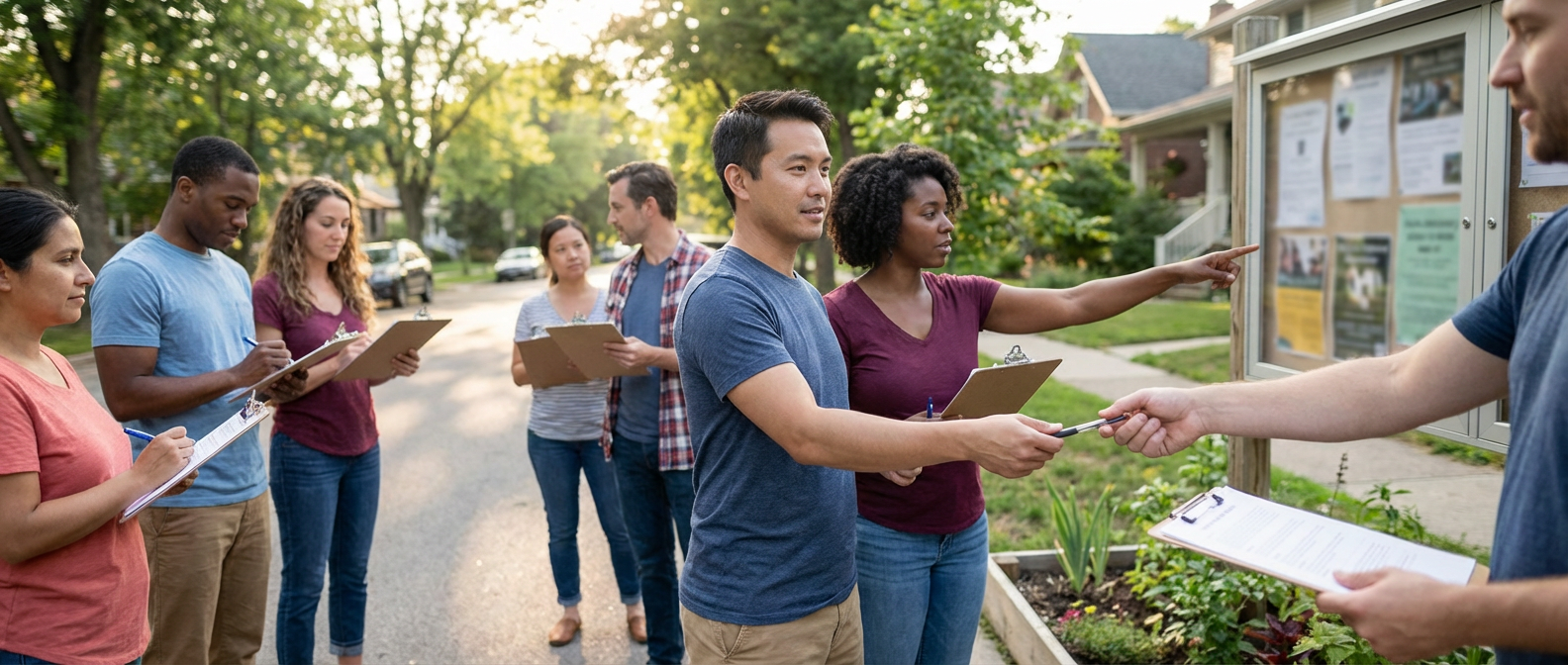
Why Your Neighborhood Issue Isn’t Ready for City Hall (And What to Do About It)
The Mobilization Trap We All Fall Into
You’ve seen it happen. A developer wants to build something unpopular. The city announces a new bike lane that will eliminate parking. A beloved local business gets priced out. Within hours, neighbors are posting angry messages on Nextdoor, someone creates a Facebook group, and before you know it, there’s talk of storming the next city council meeting with pitchforks and poorly designed yard signs.
Here’s the uncomfortable truth I’ve learned from watching dozens of these neighborhood mobilization efforts: most of them fail spectacularly. Not because the cause isn’t just. Not because people don’t care enough. They fail because we mistake anger for strategy and confuse showing up with being prepared.
The conventional wisdom says that grassroots organizing is about passion, numbers, and making noise until someone listens. I used to believe this too. Then I started paying closer attention to which neighborhood campaigns actually moved the needle and which ones became cautionary tales about wasted civic energy. The difference was shocking.

What Successful Mobilization Actually Looks Like
The most effective neighborhood organizing I’ve witnessed has a counterintuitive trait: it starts slow and boring. Take the residents of Maple Ridge who successfully pushed back against a proposed gas station near their elementary school. Before they held a single rally, they spent three months doing homework.
They researched the zoning code. They attended planning commission meetings about unrelated projects to understand how decisions actually get made. They identified which council members had voted how on similar issues in the past five years. Most importantly, they talked to city staff before taking adversarial positions, learning that the planning department had its own concerns about the project’s traffic impact.
By the time they showed up to their first public meeting, they weren’t just angry neighbors. They were informed stakeholders who could speak the language of municipal government. They knew which legal standards applied, which precedents mattered, and which arguments would actually influence the decision makers. This mattered more than they’d expected.
The gas station proposal was withdrawn before it ever came to a vote. Not because residents made more noise than usual, but because they made better arguments supported by better research. The difference was night and day.
The Case Against Ready, Fire, Aim Activism
The impulse to mobilize quickly feels righteous. When you see something threatening your community, waiting feels like accepting defeat. But premature mobilization often backfires in ways that make future organizing harder.
Consider what happened when residents learned about plans for a new homeless services center in their neighborhood. The initial response was swift and emotional. Neighbors packed a city council meeting, many speaking passionately about property values and safety concerns. The local news covered it as a story about NIMBY opposition, and affordable housing advocates began organizing counter-protests.
Within two weeks, what could have been a productive conversation about implementation details became a polarized battle between “compassionate” and “selfish” neighbors. The city moved forward with the original plan rather than engage with a community that now appeared uniformly hostile. Everyone lost.
But here’s what most people missed: many of those same neighbors had legitimate concerns that could have improved the project. They knew about ongoing issues with inadequate lighting and limited transit access that would affect both housed and unhoused residents. They had insights about traffic patterns and school pickup times that could have informed better site planning. All of that local knowledge went to waste.
The rushed mobilization squandered an opportunity for the kind of collaborative problem-solving that creates better outcomes for everyone. Instead of being seen as potential partners with valuable local knowledge, residents became obstacles to overcome.
Building Power Before You Need It
The most successful neighborhood organizers I know treat civic engagement like tending a garden, not fighting fires. They build relationships with city staff during quiet periods. They attend routine meetings about boring subjects. They develop reputations as residents who bring solutions, not just complaints. It’s less exciting, but it works.
This approach requires a fundamental shift in how we think about neighborhood organizing. Instead of reactive mobilization, it’s proactive civic participation. Instead of showing up when you’re angry, you show up when you can be helpful. I know it sounds painfully earnest, but bear with me.
Start by picking one city meeting to attend monthly, even when nothing directly affects your street. Learn how public comment periods work. Watch how different council members ask questions and what kinds of information they find persuasive. Introduce yourself to the staff members who work on issues that matter to your neighborhood. Yes, it’s tedious. But tedious beats ineffective.
When you do need to mobilize around a specific issue, you’ll have credibility, relationships, and institutional knowledge that turn your neighbors’ passion into actual influence. You’ll know which fights are worth having and which battles are already lost before they begin.
The Long Game of Neighborhood Power
Effective neighborhood organizing isn’t about winning every fight. It’s about building the capacity to influence decisions before they become fights at all. This means accepting that some of your energy will go toward understanding systems rather than fighting them, and some of your time will be spent on issues that don’t immediately affect your daily life. I get it, that’s a tough sell.
The residents who successfully advocated for traffic calming measures on their street didn’t start by demanding speed bumps. They began by volunteering for the city’s neighborhood traffic safety committee, learning how traffic studies work, and building relationships with transportation planners. When speeding became a problem on their street, they knew exactly how to document it, which data would be compelling, and who had the authority to act. The whole process took six months instead of six years.
This approach requires patience that feels almost unnatural in our era of instant everything. But democracy was never designed for instant gratification. It was designed for sustained engagement by informed participants who understand that today’s small investment in civic knowledge becomes tomorrow’s neighborhood influence.
The next time your neighborhood faces a challenge that requires collective action, resist the urge to immediately mobilize. Take a breath. Do some homework. Build some relationships. Then organize from a position of knowledge rather than just passion. Your neighbors will thank you, and your city council members will actually listen.
What’s one boring city meeting you could commit to attending this month? I’d love to hear about what you discover there, and how it changes your perspective on what effective neighborhood organizing actually looks like in practice.