AI Governance Diverges: What the EU’s Bold Move and America’s Retreat Tell Us About Democracy in the Tech Age
Two Paths Emerging from the Same Starting Point
We’re watching something genuinely consequential unfold in real time, and I want to walk you through it the way I’d explain a city budget showdown to someone who’s never paid attention to municipal finance before. Because this isn’t just about artificial intelligence. It’s about how democracies make choices when the stakes are massive, the technology is moving faster than we can regulate, and reasonable people disagree about what “safety” even means.
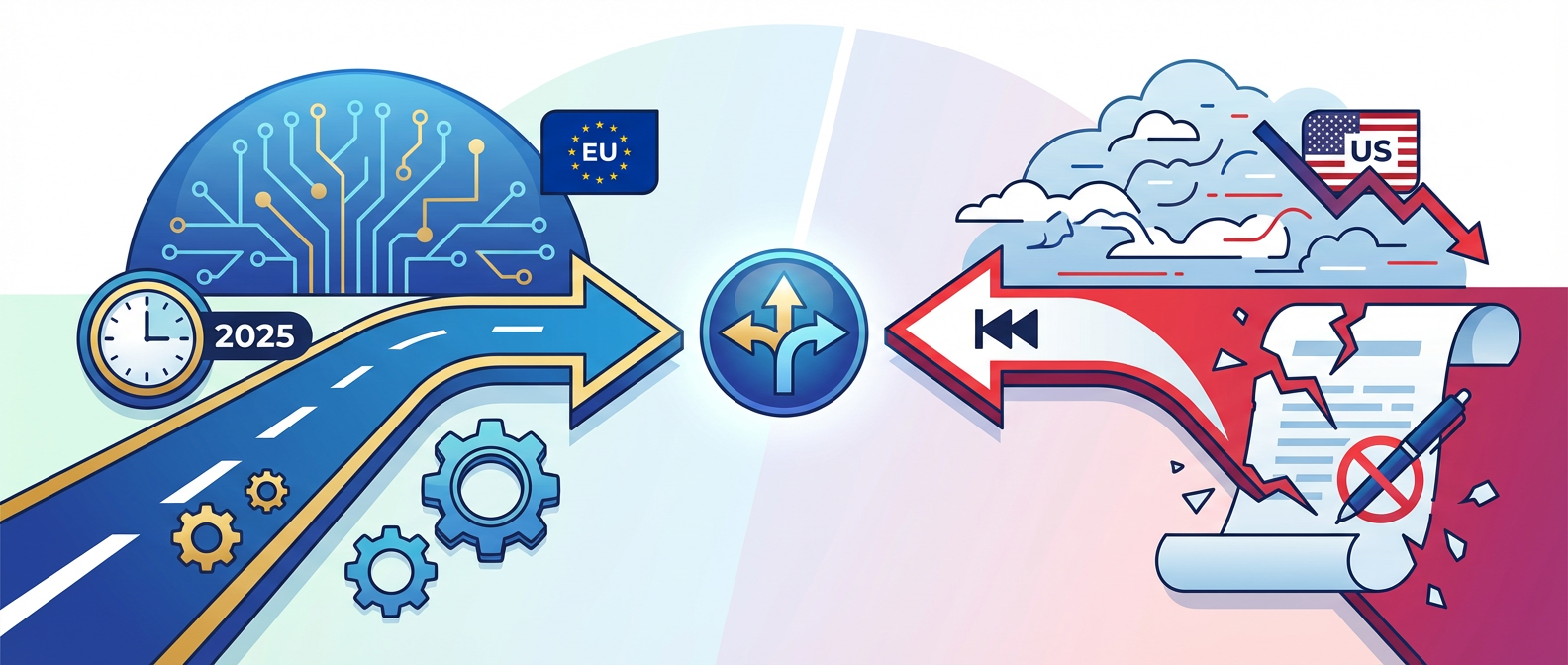
On August 2, 2025, the European Union’s AI Act entered its full enforcement phase. This wasn’t a soft launch or a suggestion. The rules on high-risk AI systems became binding law. Developers now face mandatory conformity assessments, detailed logging requirements that create an audit trail, and built-in human oversight mechanisms. Violate these standards and you’re looking at fines up to €30 million or 6% of your global turnover, whichever is larger. For context, 6% of a major tech company’s revenue is real money that gets real attention in boardrooms.
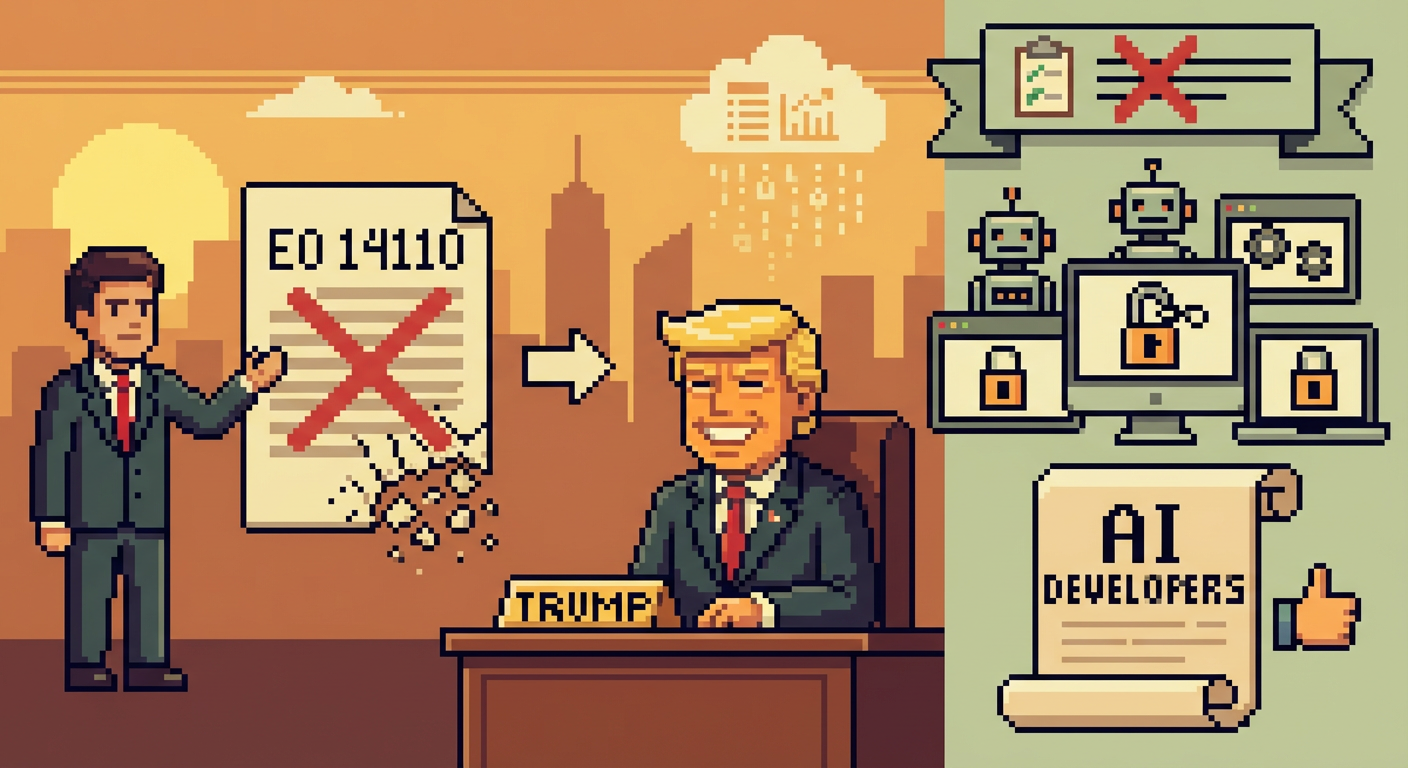
Meanwhile, in the United States, President Trump revoked Biden’s October 2023 Executive Order 14110 on AI safety during his first week in office. That order had required mandatory safety reporting from frontier AI developers. It created accountability structures. It built guardrails. It’s gone now. The National Institute of Standards and Technology’s AI Risk Management Framework still exists technically, but it lost its federal interagency mandate after an Office of Management and Budget revision in March 2025. The framework didn’t disappear. Its teeth did.
Understanding the Regulatory Gap
Here’s where this gets interesting from a governance perspective. The EU action and the U.S. action aren’t simply opposite. They’re responses to fundamentally different questions about who bears responsibility when things go wrong. Europe asked: “How do we protect citizens from high-risk AI systems before deployment?” The answer was structural rules with enforcement mechanisms. America asked: “How do we avoid slowing down the companies building this technology?” The answer was deregulation.
Neither position is inherently irrational. There’s a real argument that excessive regulation could push innovation to countries with fewer safeguards, creating a race to the bottom. There’s also a real argument that moving fast and breaking things works better for social media algorithms than for systems that might affect medical diagnoses, loan approvals, or criminal justice decisions. Both have merit. But we should be honest about the tradeoff.
The European Commission EU AI Act Implementation Portal details exactly what developers now need to do. The requirements are specific, technical, and demanding. If you’re building an AI system that could affect fundamental rights or safety, you need to prove you’ve done the work. You can’t just say you’re confident. That’s the EU bet: more friction on the front end saves chaos on the back end.
The Inconvenient Data Point Everyone Should Know
This is where I want you to pay attention, because this is the part that actually explains why both sides are escalating their positions. According to the Stanford HAI Artificial Intelligence Index Report 2025, 19 of the 25 largest AI model releases in 2024 came from U.S.-based companies. Nineteen out of twenty-five. This isn’t a close call. American companies are dominating the frontier of AI development.
This creates what I’ll call a jurisdictional tension. The EU says you want to operate in our market with your AI system? Fine. You follow our rules. The U.S. companies respond: we’re so dominant globally that if you force us to comply with EU standards, we’ve essentially let Europe set global regulations. So why not push back, ease the rules here, and make it easier for American companies to stay competitive? Both sides have genuine skin in the game.
This isn’t abstract. When an American AI company decides how to build a system, they’re now making a real choice. Do we build to EU standards globally and accept the compliance cost? Or do we build a lighter version for U.S. markets and a compliant version for Europe? Neither option is trivial. Neither option is perfect.
When Allies Stop Talking
The real tell of how serious this rift has become came in June 2025 when the EU-U.S. Trade and Technology Council’s AI subcommittee suspended formal coordination sessions. Let me be direct: when allies stop talking to each other in official channels, it means informal persuasion has failed and both sides are preparing for a longer conflict. These meetings don’t suspend easily. There’s bureaucratic momentum and diplomatic face involved. Suspending them signals real disagreement.
The sticking point? Mandatory pre-deployment testing standards. Europe says test your system thoroughly before you release it. America’s position is closer to: let the market test it, iterate fast, and regulate bad outcomes after they happen. These aren’t minor philosophical differences. They’re fundamentally different models of how democratic societies should handle new technologies.
What makes this particularly concerning is that neither side has given ground. This isn’t a temporary standoff where cooler heads are working behind the scenes on compromise language. The structural incentives are pushing both directions harder, not softer. The EU has invested political capital in its Act. Democratic legitimacy depends on showing that the rules matter and will be enforced. The U.S. administration has made a clear policy choice about deregulation. Reversing it would look like weakness to their base.
What This Means for How We Think About Governance
If you want to understand modern democracy, this is a useful window. We have two different democratic systems responding to the same technological challenge in opposite ways, both with defensible logic inside their own frameworks. Europe emphasizes precaution and citizen protection through structural rules. America emphasizes innovation speed and market competition. Both are legitimate democratic values.
The problem is they don’t easily coexist when one company needs to decide whether to deploy a system globally. And here’s the part that should genuinely concern anyone paying attention: this is going to keep happening. AI won’t be the last technology where the EU and U.S. diverge. Climate policy, data privacy, genetic research, quantum computing. Every emerging technology creates these regulatory divergence moments.
So what do we do with this? Understand first that regulatory conflict between democratic systems is different from conflict with non-democracies. We can argue about whether Europe or America made the right choice. We can research the actual evidence about whether precautionary regulation helps or hurts innovation. We can contact our elected representatives and tell them what we think matters. We can support organizations working on transatlantic tech policy dialogue. We can choose to learn how our own government operates and participate in those decisions.
The civic muscle we need right now isn’t accepting what our preferred politicians tell us about AI governance. It’s learning enough about the actual regulatory choices to have an informed opinion, then making noise about what we think is right. Democracy doesn’t work when citizens outsource thinking about technology policy to whoever seems smarter. It works when regular people understand enough to participate.
What aspect of AI governance concerns you most? Is it the safety question, the innovation speed question, the global competition question, or something else entirely? I’d genuinely like to know what you’re thinking about here.